Friday, August 9, 2013

I Will Miss These Things

 
At the age of fourty-four, I am surprised to find myself to be the kind of person who has moved a lot. There was Texas and Montana. In Washington, I had stints in Snohomish, Lake Stevens, Everett and Seattle. Even in Olympia--where I lived for many years--I moved around: The Mill House, Cherry Street, The Duplex, The Studio Apartment, The House That Burned Down, The Apartment By Lincoln, The Bigelow House and The Boat. And in Philly: The Lombard Apartment, Sloan Street, The House For Wayward Girls, and The Snuggler.

For the past two years I have been living in Aurora, New York, where I was the Fellow at the Wells Book Arts Center. I am leaving Wells for a tenure track position at the University of Alabama, and I am excited for the move to Huntsville. However, there are things I am going to miss about my life in the village of Aurora.

With a population of about 725, Aurora is really, really, really small. There is something unique about living and working in a place of such an "intimate" size. I walk one block to Main Street. There are no traffic lights. I can count the local businesses on one hand.

There is no garbage pick-up in Aurora. Every Saturday, Curt (my boyfriend) and I would take our garbage and recycling to the dump, then we would go to breakfast at The Man in the Moon Bakery. This is my favorite breakfast in upstate New York, and I am going to miss it.
I am going to miss seeing my neighbor Britt, who lived across the street from me. I think about all the times that Britt's garage door was open and I could see her 4 foot hand-made sign: Obama got Osama. And I am going to miss pondering over her uncanny resemblance to Barack Obama. I will always remember the time I rode by Britt's house with the air low in my bicycle tires and she yelled after me: "Your tires are flat! That good for nothing boyfriend of yours is nothing but eye candy!" And the next time I saw her she pumped up my tires.

I am also going to miss my identical twin neighbors Lorie and Julie. We shared a driveway and their cars were also exactly alike. Exact same color, exact same style. Identical.

I am going to miss this tree and the fancy desserts from the Inn.
I am going to miss team Chichi, and my two friends John and Heather. Wednesday nights we played trivia at The Plant and I remember when I first started playing I was really nervous because I have never liked team sports. A gin & tonic calmed my nerves and eventually I found my place on the team: poetry & literature (multiple choice only); 1980's movies; and the very very occasional art question.
Trivia DJ Dan, me, and Curtles.
I am going to miss the fireworks on Lake Cayuga.
I am going to miss Nancy, my boss. I will miss walking into the Book Arts Center and wondering when the greenhouse will be restored so it can it can become the papermaking studio it was always meant to be.
I will miss my office.
I am going to miss looking at the make ready that Sarah left behind. So I am leaving my owl to keep her periodic table company.
I will miss my studio.
I will miss Buddha.
I will miss the Vandercook Universal I automatic, on which I printed oh-so-many things. And I will miss looking at Werner Pfeiffer's portfolio "Alphabeticum".
I will miss the students I taught.
I will miss exploring the basement.
Mats: 12 pt. Porson Greek
Punches
I will always remember each and every one of Michael Bixler's printing tips.

And I will never forget this sound:


And the smell of hot lead.


I will miss driving to the big city of Rochester to eat at Dinosaur Barbeque, where over dinner we would take in the view of the Genesse River.
I learned to play folf in upstate New York. Curt and I explored every course we could find. My favorite was the course in Danby and I am going to miss it, especially this picnic area. If Communist Architecture had a baby with The Future, it would look like this.
I will miss turning the pages of books from the Fiske Collection at Cornell.
Willard Fiske's book plate
Goodbye New York spring.
Goodbye Grisamore Farm's berry season.
Goodbye green...
...and white...
...and blue.


Friday, April 19, 2013

Monotype Casting & Specimen of Bembo

I need to write a little bit about monotype casting.

One aspect of my fellowship at the Wells Book Arts Center is that I work at the Bixler Letterfoundry once a week. Michael Bixler has been working for many years in monotype casting and composition. I have never met anyone quite like Michael. To give you a sense of that kind of man he is, I will tell you that he letterpress prints his syllabus and quizzes for his letterpress 1 class.

Final exam: letterpress 1

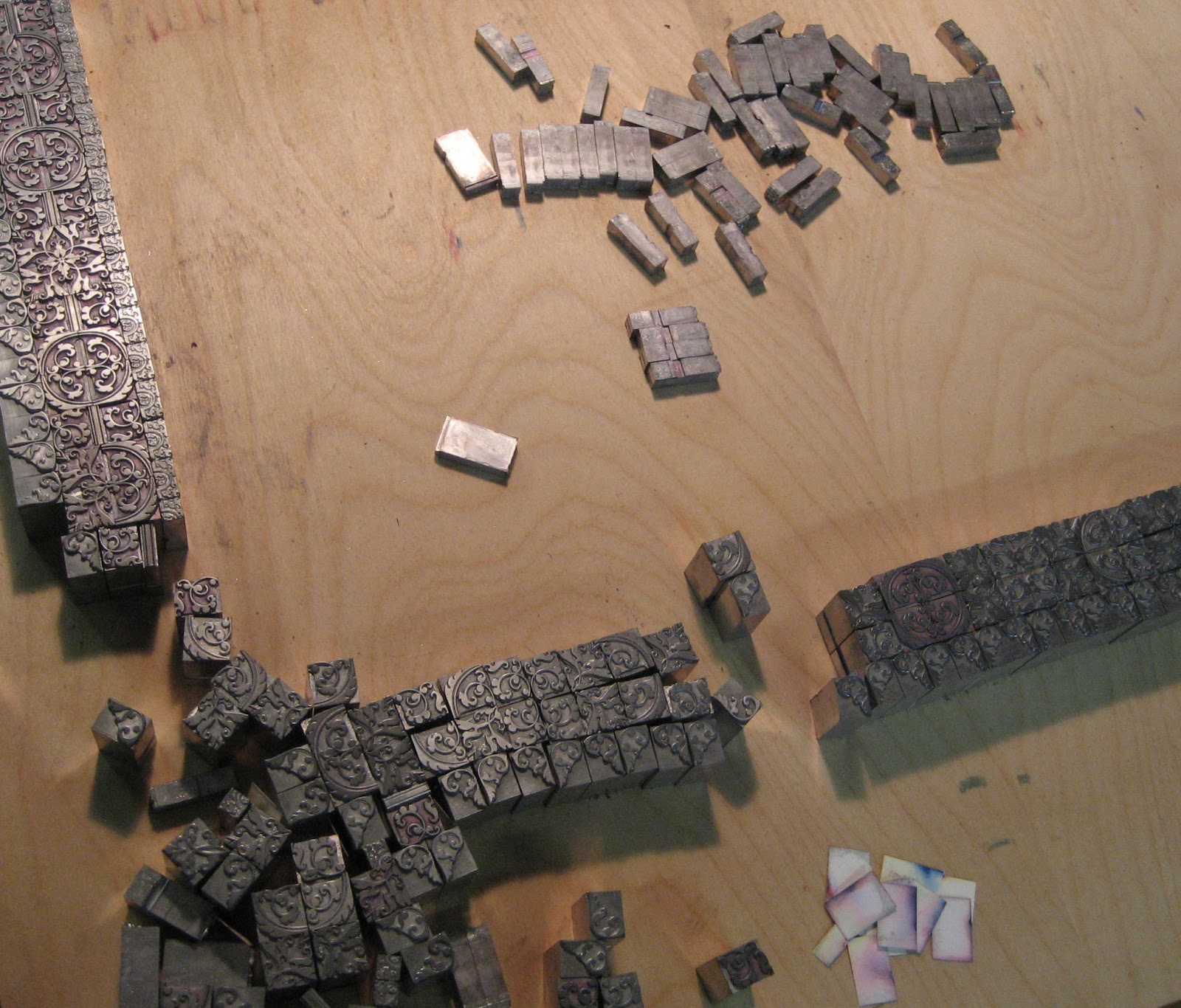
On one of my first days of working at Michael's shop, he asked me to reassemble a border of ornaments that has been pied (dropped).


Michael gave me the broadside (pictured below) as the pattern to work from as I re-set the boarder. As I work on the boarder, we talk about the broadside. And I begin to understand that Michael thinks and sees letters primarily as physical objects. He wrote the text for this specimen sheet, considering the space each letterform takes up in the bed of the press.


Perhaps you are not familiar with monotype casting? It is a mechanized system for casting individual letters, in a particular order. However, in contrast to linotype casting, it is flexible for making corrections before printing. As stated on the Bixler Press and Letterfoundry website: "Linotype was meant for speed, but monotype was meant for perfection." The monotype keyboard uses a binary system of punching holes on a paper ribbon, as the text is keyed in.

(Video below shows Wells Book Arts student Jessie Reich keying in her text.)

The paper ribbon is attached tot he caster--air is pushed through the holes in the paper, which tells the machine where the letter is located on the map. Hot lead is forced into the letter mold and finally the letter is pushed out onto the galley tray.
(This video documents the paper ribbon attached to the caster.)

(This video documents the movement & sound of the caster
as type is distributed out onto the galley.)

I have become very interested in the physicality of type and the limitations of a type case. Each compartment can hold only so many letters, however the possibility for word composition is seemingly endless. I decide to cast my first case of type: 14 point Bembo.

Freshly cast 14 point Bembo.
The lay of the case.
The map (pictured above) shows which compartments in the case hold which letters. I have the idea to set all of my 14 point Bembo in the bed of the press and print it. I am not sure that it's going to work--so I just start.

As the type case empties...
The bed of the press fills...
It is surprising to me how perfectly all the letters fit into the bed of the press.
When the case is empty...
...I pull a print.


Here's a detail of the printed text.

Specimen of Bembo, 2012, cast and handset type, letterpress printed, 15 x 22.5 inches.
As I look at the final image, I am pleasantly surprised at how architectural this overall image looks. Something that I wish to share is that Michael things that this project is totally crazy. For example, I didn't use any line leading. He would ask me: but without leading, how did you set it? How did you print it?

And I would say: I don't know I just did.

And then we would both chuckle--he would shake his head.

That is the interesting thing about treading into some of these deep dark areas of craft: things that don't see crazy to anyone else in the artwork, are absolutely outlandish to a master-caster.


Tuesday, March 26, 2013

Experiments with Calligraphy & 2181, 2153, 2125, 2097, 2069, 2041, 2013, 1985, 1957, 1929, 1901 Calendar


The letter "R", New York City Subway, 2010


When I first heard about Wells College, I was very surprised to learn that it had an amazing Book Arts Center. And when I arrived at Wells Book Arts Center I was very surprised to learn that it has a Scriptorium. 

To be perfectly honest, I had never thought about calligraphy, but my office and studio are down the hallway from the scriptorium. One day I started looking at calligraphy, and I had this epiphany (which is pretty embarrassing to say out loud, because it so obvious): all type design comes from written letterforms.

Calligraphy demonstration by Julian Waters, 2012
I begin to look at traditional calligraphy and think about contemporary graffiti—to me they are estranged twins, living the same life, apart from each other.
Calligraphy demonstration by Julian Waters, 2012, Pen and Ink
Graffiti, Unknown Artist, 2009 Warsawa, Poland

I start noticing prints I have been collecting over the years that have carved or cut text.

Artist unknown, Edo-1771, Mokuhanga print, 6 x 5 inches

Calendar by Keisuke Serizawa, b. 1895 - d. 1984, stencil dyeing 6 x 4 inches
I begin to experiment with my own handwriting. 


Handwriting Sample 1, 2012 Ink on paper, 12 x 9 inches
Handwriting Sample 2, 2012, Ink on paper, 12 x 7.5 inches
I decide to make a one-week project that brings together hand written, hand drawn, and letterpress printed elements in a small book project. 


2181, 2153, 2125, 2097, 2069, 2041, 2013, 1985, 1957, 1929, 1901 Calendar,  lettepress printed in 2012, View of enclosure and cover, 5 x 5 inches closed
I create a mock up.


I do a lot of writing.


And some drawing.
 
Trees, 2012, Ink on paper, 11 x 9 inches

I scan everything, make files, and make polymer plates. For this little book, there are so many files and plates it’s totally ridiculous.


And then I print. 


And print.


 This is one of 12 months represented in the calendar. 
The calendar can be used every 28 years—past, present, or future.
2191, 2153, 2125, 2097, 2069, 2041, 2013, 1985, 1957, 1929, 1901 Calendar, letterpress printed in 2012, 10 x 5 open.
(Detail) 2191, 2153, 2125, 2097, 2069, 2041, 2013, 1985, 1957, 1929, 1901 Calendar, letterpress printed in 2012.   
And around this same time I received a copy of a Christmas letter written by my mom in 1981 and a copy of love letter that my dad had written to my mother in the 1960’s. 

Handwriting samples, Mom (L) & Dad (R)
Seeing their writing captures them more closely then a photo. And I start thinking about the beginning of writing, the time when people are able to write the thoughts from their head down on a piece of paper—and this paper can then travel from place to place, person to person. It can be put away, and then retrieved later. Thoughts a person wrote in 1981 can be then re-read in 2012. My interest in language as text begins with the development of writing, the invention of the printed word, and the mechanization of typesetting in printing multiples.